CrossFit for beginners — what your first month actually looks like
On-ramp courses, WODs, scaling and the DOMS: what really happens in your first four weeks of CrossFit, what to bring, and how to pick a box that suits you.
· Updated · The Studiomaps editorial team

CrossFit has a reputation problem. From the outside it looks like heavy barbells, competitive people and a vocabulary nobody explains. From the inside, the first month is almost entirely technique work with an empty bar.
Here is what actually happens in your first four weeks, what the jargon means, and how to tell a good box from an average one. Studiomaps lists 573 independent CrossFit boxes across the UK outside the big gym chains.
You start on an on-ramp, not in a WOD
Almost every UK box puts beginners through an on-ramp first — variously called Foundations, Elements, Fundamentals or Intro. It usually runs across two to four weeks and four to eight sessions.
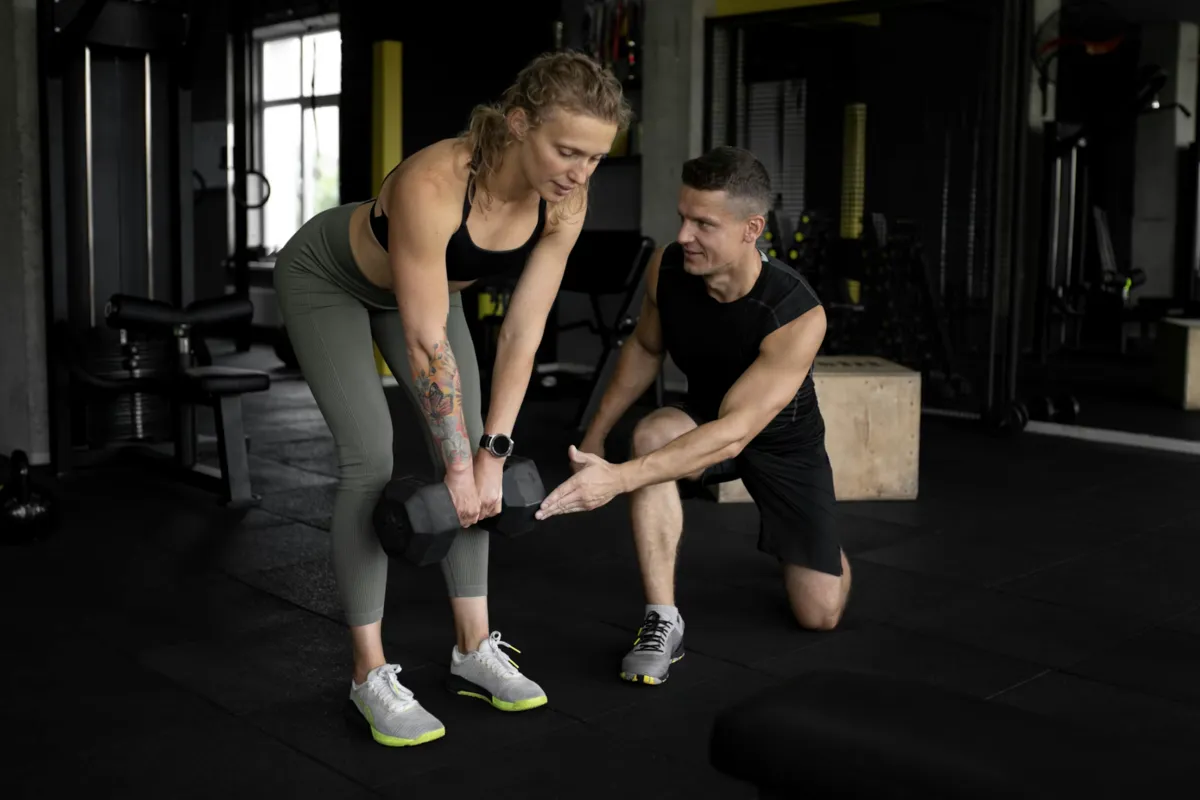
There is no competition and no heavy lifting. You learn the movement patterns — squat, deadlift, press, clean, snatch — with an empty bar or a piece of PVC pipe. This is precisely why CrossFit is safer for beginners than its reputation suggests: nobody puts you near a loaded barbell before the movement is sound.
Expect to pay roughly £50–£120 for the on-ramp, and many boxes credit it against your first month's membership.
The vocabulary, decoded
- WOD — workout of the day. Everyone does the same one, scaled to their level.
- Scaling — adjusting a movement to suit you: banded pull-ups, press-ups from the knees, lighter loads. Scaling is the system working, not you failing.
- AMRAP — as many rounds as possible in a set time.
- EMOM — every minute on the minute.
- Box — a CrossFit gym.
- PR / PB — personal record.
- Metcon — metabolic conditioning; the breathless part.
How a class runs
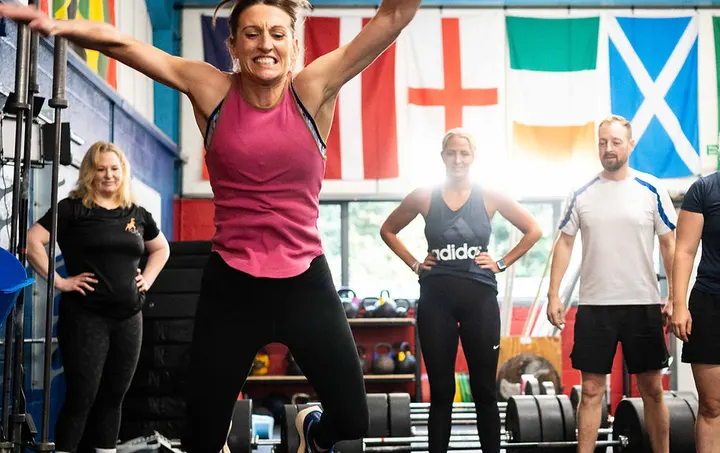
Classes are a full hour and coached from start to finish: 10–15 minutes of warm-up, then a skill or strength piece, then the WOD itself (usually 8–20 minutes), then a cool-down.
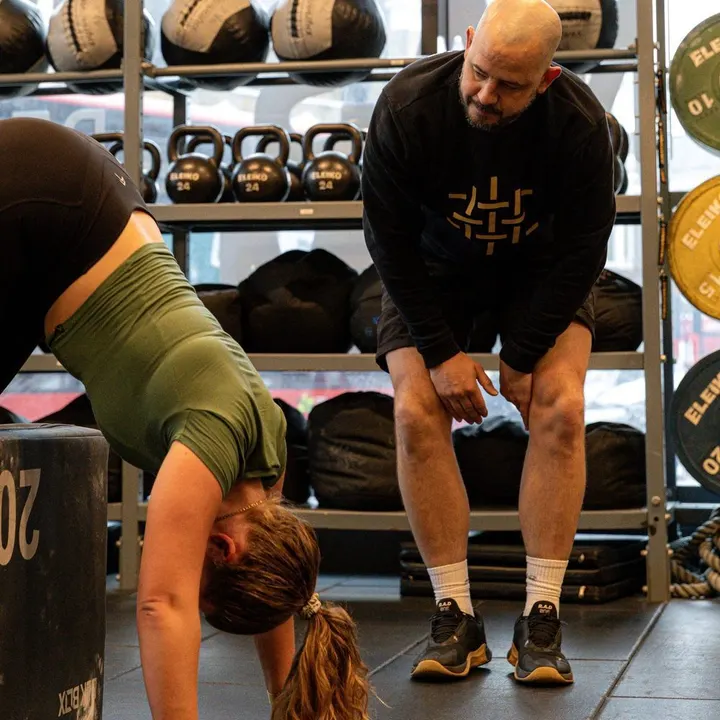
Group sizes are typically 8–16. The coach watches every rep and will stop you mid-set to correct form — that supervision is the real difference from training alone in a commercial gym.
Your first four weeks, honestly
Week one. Everything is new and you get out of breath faster than you expected. The soreness arrives 24–48 hours later and is worse than anything you remember from other training. It settles down.
Week two. The movements start to make sense. You realise a lot of the breathlessness was inefficient technique rather than poor fitness.
Week three. The first WOD you get through without stopping. This is where most people get hooked.
Week four. You know people's names. That, more than the programming, is why CrossFit retention beats standard gym memberships.
Train two or three times a week for the first month. Five sessions a week from a standing start is the fastest route to an overuse injury.
How to choose a box
Coaching depth matters more than the kit. Ask how many coaches the box has and how long they have been there — high coach turnover is the clearest warning sign.
Second question: is there a dedicated beginners class, or are newcomers scaled into the general class? Both work, but the second demands much more of the coach.
In London, CrossFit Shapesmiths (5.0 ★, 350 reviews), CrossFit Dawn (5.0 ★, 228 reviews) and Gymnasium Wandsworth (5.0 ★, 230 reviews) are among the highest-rated boxes, the last of which also programmes HYROX — useful if you want a race to aim at, as covered in what is HYROX.
Outside London, look at CrossFit Glasgow (4.9 ★, 273 reviews), CrossFit Sale Moor (5.0 ★, 225 reviews) near Manchester, CrossFit Huntsman Gym (5.0 ★, 222 reviews) in Hertford, Motion CrossFit Surbiton (4.9 ★, 218 reviews), Forge Functional Fitness (5.0 ★, 210 reviews) in Sheffield, CrossFit Chichester (4.9 ★, 204 reviews) and Aphobos CrossFit (4.9 ★, 181 reviews) in Bromley.
What to bring
For your first session: training kit, a water bottle and ordinary trainers. Flat-soled shoes help but are not essential. Lifting shoes, hand grips and your own skipping rope can wait until you know you are staying.
What it costs
Most UK boxes charge £90–£160 a month for unlimited classes, with London at the top of that range and limited-class options cheaper. Add the on-ramp fee up front. Many boxes run an intro offer for new members — see the current offers.
Try two boxes, not one
The programming across good boxes is more similar than the atmosphere is. Book a trial at two before you commit; the difference will be the people, not the movements. Our checklist in how to choose the right fitness studio covers what else to ask.
Browse boxes near you: CrossFit in London.